Monday, September 29, 2008

Antique Ink Bottles

An ink bottle was made of glass and typically sat on a desk. The writer would dip the pen (or quill) into the bottle to put more ink on the pen. Because they set on a desk, ink bottles were often decorative. Ink wells (as opposed to "ink bottles") were typically metal with a glass insert, often ornate, and sat on a desk. The larger master ink (pint or quart size) was used to store ink and refill the smaller ink wells. Ink bottles were shaped so they were hard to tip over.

Inks come in many different shapes:

  • Cone inks were used from the early 1800s to early 1900s. They often come in a variety of colors as shown in photo below:
  • Umbrella inks were a "fluted-cone stand", with eight connecting panels to form the sides; they were used from 1820s to 1880s. Pontilled umbrella inks in fancy colors are some of the most expensive inks sought by collectors.
  • Hexagonal and octagonal ink bottles were used 1835-1865.
  • Igloos (or Turtles) were used 1865-1895. See Lucy Faulkner's newsletter article on Turtle Inks.
  • Barrel shaped ink bottles were used 1840-1900. The barrel shape is bigger in the middle than the ends, like an old wine/beer barrel.
  • Square shaped ink bottles were used after 1860.
  • After 1900, most inks were cylindrical (like a spool of thread), square, or rectangular shaped.
Burst lip English inks were produced from 1860s to 1930s. The invention of the ball point pen in the 1930s signalled the end of ink wells.

The "T & M" bottle classified as an ink in Covill's Ink book has since been discovered to contain a product called "Bear Grease Pomade" that was put out by a firm called Taylor and Moore. This info provided by Emmett Baker, Email: inkwells@webtv.net who is a long time ink collector and was a friend of the late William Covill.

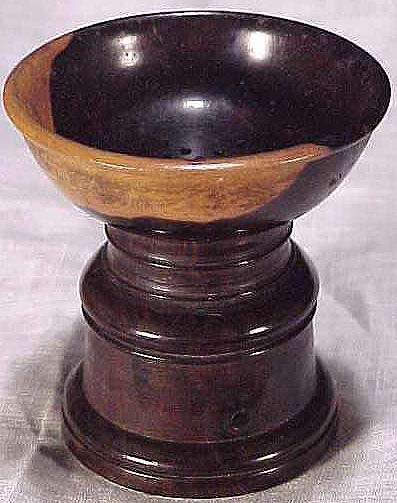
A sander was used before blotting paper was invented. The old paper didn't absorb ink rapidly and the dip pens often left much ink, so to dry the ink and keep it from smearing, a fine sand was sprinkled on the ink. After absorbing and drying the ink, it was poured back in the sander to be used again. That is why sanders have a bowl like top. Click here to view a sander bowl owned by Ed & Lucy Faulkner.

Cleaning Antique Bottles

Bottles are worth more when they are clean and in at least near mint condition. Many old bottles are called "dug" because they were dug up after having been underground for many years. Being underground for a long time exposes the bottles to water which stains them on the inside and outside (the chemicals in the water do the staining). A good scrubbing with a brush and warm soapy water does a good job in removing most dirt, but is usually ineffective in removing stains. While chemicals like muriatic acid (dangerous), Lime Away, Efferdent, or Dexters can provide some help in removing this water stain, these chemicals usually do not work to completely remove the stain. Tumbling the bottles with copper shot for many days is usually the best way to remove most of this stain. Professional bottle cleaners use tumblers and usually charge about $15 per bottle.

Here is some help on how to clean your antique bottles.
Note that a separate page has been created for Digging Antique Bottles.

  1. See Glenn Pochs' articles on cleaning bottles.

  2. CHEMICAL SAFETY AWARENESS WHEN CLEANING GLASS COLLECTIBLES by RICK BALDWIN

  3. Jar Doctor cleans bottles and sells cleaning supplies like machines, canisters, oxides and accessories.
    Contact: Jar Doctor, c/o R. Wayne Lowry, 401 Johnston CT, Raymore, MO 64083.
    Voice: 816-318-0161, Fax: 816-318-0162, Email: JarDoctor@aol.com

  4. Bottle Repair Service, James Eldridge, 4836 W. Commonwealth Place, Chandler, AZ 85226 Phone (480) 785-2353, Email: bottlmastr@aol.com
    Note: because liquid plastic resin needs at least 70 degrees in order to cure properly, and the plastic resin is highly toxic requiring outdoor ventilation, James can only do repairs between the months of May and Sep.

  5. Bottle Tumbling Service by Rick Kern

  6. Gunnell's Bottle Cleaning & Polishing. We clean embossed and painted label bottles, jars and jugs. Call (336) 969-9643 in Rural Hall, NC.

  7. Facets Glass and Antique Restoration is a London-based antique glass repair firm. They repair and replace a variety of antique and modern glass as well as blowing our own glass in a range of colours. They also perform other specialist repair services such as rebristling antique brushes, silver replating and engraving.

  8. Bottle Cleaning Machines by Bob Roberts, 166 Zeb Cline Road, Shelby, NC 28150, phone: (704) 482-7200 (call between 8-11pm EST), Email: 5stam@bellsouth.net

  9. Deadwood Doug's custom antique bottle polishing

  10. Cleaning Antique Bottles is a helpful page published by Digger Odell.

  11. Bottle Brushes For Sale by Digger Odell.

  12. Professional Bottle Cleaning $15 for single bottle, discount for more than 2. Jerry Stokes, Email: jbottles@usaor.net phone (412) 274-6438, address: 11 Wilson Ave, Cheswick, PA 15024.

  13. Bottle Cleaning by Jennrog Collectables, 99 Lawrence St., Pepperell, MA 01463, phone: (978) 433-8274.

  14. Spring Steel Probes (5/16" or 3/8" size) for $25 each. Replacement tips are $5 each.
    Raybrite Tumbling Powder for $5.25/lb.
    Contact Chip Cable, Email: chpcable@weld.com, Address: 235 Main Entrance Drive, Pittsburgh, PA 15228, Phone: 412-343-4955.

  15. Bottle Doctor specializes in cleaning rare sick bottles. Dr. Allen in NV (702) 776-2511.

  16. CLR stands for Calcium, Lime, and Rust remover and it works pretty well, but usually does not remove all stain. CLR works better than Dexters. CLR probably works the same as Lime Away. CLR is available in most grocery stores in the cleaning section (along with Comet and 409).

  17. A product called "the Works toilet bowl cleaner" contains a dilluted (but not much) solution of hydrochloric acid. It is the only Hydro I have ever found on the store shelf. It totaly eats rust and other stains right off. Use with ventilation!!! It doesnt touch the magnesium leaching stains but nothing does. Info courtesy of Eddie, Email: ebrater@cinci.rr.com.

  18. Dexter's Stain Remover advertised as "a cure & remedy for sick glass ... for all stained antique glass ... mineral, rust, and calcium deposits". Send inquiries with SASE to 15140 Washington St., Riverside, CA 92506

  19. Bottle Brushes assortment of 15 (7 nylon bristles, 8 hog-bristles) can be ordered by mailing $25 to:

A Basic Guide to Collecting Glass Bottles

Collecting glass bottles is another popular hobby that is being pursued fervently by ardent collectors and can fetch you a good sum. The antique varieties convey its historical past and they are invaluable as they were manufactured by hand and no two are same. Some medicine bottles have the names of chemicals and warnings in the design unlike the present ones which have labels. The other antique ones that you can collect are ink wells, mineral water, vinegar, whisky, cosmetic, beer and torpedo. Syrup bottles for making sodas that were used by druggists are also a rarity and are worth a lot.

Why are Glass Bottles in Demand?

The reason why people collect them is because of their unusual shapes and colors, their designs which makes them rare and in demand. You may find egg shaped bottles which were the trademark of Hamilton's bottles or those shaped like log cabins, women's figures, ears of corn or a pig as in the case of bitter bottles that are no longer produced. You may also find sealed wine bottles, stoneware containers, cream pots, ointment pots, pot lids, clay pipes and heads of china dolls which all come under the classification of bottle collecting. Even unique colored flasks which are scarce are considered antique glass bottles.

How to Collect Glass Bottles?

You can find these rare items at flea markets, old dumps and houses, ghost towns and the campsites that were used by the early pioneers. You can also find them in car boot sales, antique fairs and auctions and bottle shows as well.

How to Recognize Genuine Antique Glass Bottles

You need to closely examine the lip for if they are antique pieces then they will have crude lips when tools were not used to create smooth rings around the lip and neck of the bottles. You can also distinguish the antique by its greenish color which was the preferred color of the early bottle makers. The bottom of the bottle should give you some hints also when bottles had rough and round circles You can get good prices for your collection of glass bottles. Those that have pictures as trademarks and those that have embossing done are in great demand as well.

Care Required for your Glass Bottles

You should be very particular in preserving these rare antiquities and keeping in mind their fragile nature you should build a case with arrangements to hold the bottles intact. Any kind of collision can result in destruction and loss of your priceless treasure. Always keep the glass bottles clean and away from direct sunlight.

Accumulation of dirt can discolor your collection thus modifying the value as well. You need to check various guides that can give you tips on the types of bottles that you need to collect, how to find out the value of your bottles and how to detect the spurious ones.


April Kerr

Understanding Early Glass

Understanding how it was made; molten glass was blown, as one would blow a balloon, then shaped with tools or molds by a "gaffer," is the first step toward identifying valuable antique glass in your own back yard. And, it does show up, frequently. One of my mom's friends, Shelly, bought a miniature "blown" glass bottle with an "applied" handle at a local tag sale last spring. Despite a small "heat-check" crack, a crack that happened in making when the red hot gooey handle was applied to the cooler bottle, the insignificant appearing two-inch tall amber demijohn was sold for four-hundred dollars-fair profit on a nickel investment!

Shelly 's expertise is toys, not glass. She encounters hundreds of inexpensively priced glass pieces every week when she's making her antique hunting rounds.. She took a shot on the bottle because it was a low risk gamble, and it looked interesting. Here's a few tips that may rouse your interest if you happen to cross paths with an old piece of glass.

Inspect the base for a "potil mark." Gaffers held the red-hot glass gobs they fashioned with an iron "pontil rod" which was snapped off when the article was finished. This hand-crafted glass making technique leaves a trail for antique detectives; a round jagged scar in the middle of the base. Sometimes, especially in finer pieces made after 1790, this pontil scar was removed by polishing, resulting in a smooth bowl-like indentation called a "polished pontil." A pontil mark identifies "blown" glass, and opens the door to the possibility of age and value.

Inspect the base for wear. Remember the "U" rule of thumb in the "ABC's of Antique Collecting: Unless wear is where it belongs, it does not belong." Old glass objects will have tiny flat spots on those small areas of the base where the object would come into contact with a table, etc.. Note, that an uneven gaffer-fashioned base seldom presents a flat surface, and that a base which has been "worn" in non-contact areas is quite probably a fake.

  • Examine "molded" glass. Figural flasks, decanters, embossed bottles, decorative "lacy" glass, pattern glass, and many other old glassware items were shaped in molds. Unfortunately, fakes and reproductions of early molded glass far exceeds original items today. Authentic pieces are weighty and sharply-edged compared to contemporary examples. Identifying irregularities like "spill-over," where too much glass was poured into the mold, and "annealing lines," hair-like inconsistencies on the surface, can also be of aid in ferreting-out old glass.
  • Look for a few bubbles in the glass. Air bubbles were evidence of shoddy quality to older day glassmakers, nevertheless, some did appear. Bubbly glass, should purchased by only those intent on building a collection of Mexican souvenirs.
  • Listen for a "ping." When tapped, early "flint" glass emits a bell-like tone. Not all old glass rings, however. "Lime" or "soda" glass and closed-neck pieces like bottles and decanters seldom "ping."
  • "Extrinsic decoration;" decoration introduced to glass after it was fashioned and allowed to cool, like cutting, engraving, etching, enameling, and gilding, can add considerable value to glass. This is especially true if the work is well-executed and gives an indication as to its history. A recently discovered bottle with "Amelung" style engraving is expected to bring in excess of $20,000 at a Rhode Island auction this month.

Early glass in color can be quite valuable. Authentic glass can often be recognized by the vibrancy of its color. Recognition can only be learned by experience. Visit a museum, like the Corning Glass Museum, in Corning NY, to study old glass. It 's a beautiful window into yesterday.

by AntiqueTalk.com

IOLA, Wis. (Sept. 25, 2008) -- The antiques group of F+W Media has made two new antiques identification and price guides available on DVD: Warman’s Fenton Glass Identification and Price Guide, Second Edition, and the Antique Trader Bottles Identification and Price Guide, Fifth Edition.

“At Antique Trader, we try to bring antiques enthusiasts information that will help enrich their enjoyment of the hobby,” says Antique Trader associate publisher Scott Tappa. “For so long that information has been delivered in print, and more recently via the Internet. Now we are offering digital products, and we think collectors of bottles and Fenton Glass will enjoy the searchability, image-enlarging capabilities, and tutorials offered on DVD.

With incorrectly-dated pieces presenting a challenge to collectors, the DVDs are a valuable tool to help make sense of the Fenton glass and bottles market. The products allow users to search by era, formal name, color, style, and price, then select a page or category to print out. Plus, users can enlarge the pages on the screen by 400% -- useful for close-up inspection of photos and reading descriptions.

The Fenton Glass DVD also includes tips for finding, buying, selling, displaying, and caring for Fenton Glass; 1,100 striking color photos to assist with identification; a valuable tutorial for deciphering Fenton markings; and an in-depth history of the Fenton Art Glass Co.

The Bottles DVD offers 5,000 listings with current prices; in-depth history on bottles and trademark information; contact information for collector clubs, museums, and auction companies; and tips for finding, buying, selling, displaying, and caring for bottles.

About Antique Trader
Antique Trader, a newspaper published in Iola, Wis., has served the antiques and collectibles community since 1957. Founded by Babka Publishing Co., later to become the flagship of Krause Publications’ Antiques division, Antique Trader built its reputation as the premier print vehicle for the buying and selling of antiques nationwide. Its loyal following includes antique dealers, antique show promoters, shop and mall operators, and collectors, some of whom have subscribed to the paper since its inception.

About Krause Publications
Krause Publications, based in Iola, Wis., is the world's largest publisher of leisure-time periodicals and books on collectibles, sewing and quilting, hunting, and fishing. Chet Krause, a long-time collector of coins, published the first issue of Numismatic News on Oct. 13, 1952, with nearly 1,000 readers. Today, Krause Publications, owned by F+W Media, offers over 40 periodicals, 10 hobby shows, 750 reference and how-to books, and web properties. F+W Media, an ABRY Partners, LLC company, also operates book clubs, conferences, trade shows, interactive media and education programs.

How to Give an Antique Look to Glass Bottles

By joshcrank

If you love the aged, antique look of cracked and tarnished finishes on old decorative glass and metal ornaments, you can easily give that same look to any glass bottle. By selecting bottles with interesting shapes and treating them using common art supplies, you can spread some antique elegance throughout every room in your home. Just start collecting bottles and follow the instructions below to begin.

Instructions

  1. Collect several glass bottles by any means you wish. There are many interestingly shaped bottles containing condiments, alcohol, jellies, bottled water and soda that can be washed and saved for decorating. You can also find cheap bottles at large craft stores and pottery warehouses.
  2. Thoroughly wash and dry all bottles with hot water and paper towels.
  3. Select which color of will be the top coat and which will be the bottom coat. When you're done painting, the top coat color will be the dominant color of the bottle, with the bottom coat color showing through in several cracks in the paint. The best effect is usually achieved when the lighter of the two colors is used as the top coat.
  4. Using a small paintbrush, paint the entire bottle with an even layer of bottom coat color. If you don't intend to put a bottle stopper or cork in the bottle, you may want to paint down inside the neck of the bottle as far as a couple of inches. Rinse the brush immediately and allow the paint to dry completely.
  5. When the paint is dry, use the same paintbrush to apply a layer of the crackle medium to the entire painted area. Keep in mind as you paint that thicker coats create larger cracks in the paint, while thinner coats create thinner cracks. You can vary the coat thickness over the surface of the bottle to achieve a random looking pattern. Rinse the paintbrush right away when you're finished and allow this coat to dry completely.
  6. When the crackle medium has dried, use a paintbrush to apply a very thin layer of the top coat color to the entire treated area. Be sure to brush each part of the bottle with only a single stroke; if you brush the same area multiple times or get too much paint on the brush to begin with, the cracking effect won't form properly. Once the entire area has been covered with a thin, even coat, rinse the brush and allow the bottle to completely dry.
  7. Use the bottle as a decorative element after the last coat dries. Windowsills and areas with lots of light add to the antique look of the finish.

Collecting antique glass bottles: tips tricks and pricing

Just because a bottle is old doesn't mean it's a collectible or has any value. Learn how to spot the real treasures and how much to pay.

Antique glass bottles, like many collectibles, have different categories in which they fall. Some are flasks, ink wells, soda bottles or even medicinal containers. The trick to bottle collecting is learning to recognize these categories, and to spot reproductions. Some are easy to recognize, with the name of the manufacturer in plain view on the bottom of the bottle, but some reproductions are not that easily spotted. One way to tell the real thing from a reproduction is to view the lip of the bottle. Bottles created before 1870 have a crude lip and close examination will show distinct irregularities and the molding seam. After 1880, lipping tools were used to form the lip of the bottle which, when being formed, left rings around the lip and upper neck of the bottle, but caused the molding seam to disappear. Aqua was a favored color of the bottle makers, and many bottles during this area were greenish in color, rather than clear. This is another sign that it is a genuine antique. Looking at the bottom of the bottle can also help you determine the approximate age of the bottle. Look for pontil marks, the rings made when the glass rod that helped hold the bottle while the lip was being formed, is broken off. Bottles made before 1855 should have this rough, round circle on the bottom. Around 1855, the snap tool was invented, which allowed the glass blowers to blow the glass without using the rods to hold it. This process eliminated the rough circle, but left instead, a different type of mark - something like a half circle with seam lines extending from it.

By the 1920's, bottles were being made by machines and the machines left an even different impression on the bottom of the glass. This is called the Owen's ring. It is generally a large ring, but smooth to the touch. By the late 1930's and on through the 1950's, the popular concept was to paint the labels onto the bottle. Regardless of if your bottle is colored or clear, rough or smooth on the bottom, you can get a general idea of what year it was manufactured by locating the patent number, usually from the bottom of the bottle, online or at the library. Special guides are available to help you trace these numbers. Not every number stamped on a bottle is a patent number, though. If there is a "D" in front of the number, this number very well could be just the design number.

When determining how much a bottle might be worth, check for reproductions, chips or cracks in the glass and the condition of the label, if there is one. Some bottles, not worth much 10 years ago, are now worth hundreds simply because there is a new interest in that particular bottle. Milk bottles are a good example. Some years back, these might have been worth a dollar or two but now, with more interest in that era and that type of bottle, the value has gone up considerably. Other factors that come into play in determining the worth of a bottle are age, rarity, condition, color and design. No one single factor makes the bottle a collectible but rather, several of the factors found together in one bottle makes it worthwhile for collecting.

Flasks are one of the most valued of antique glass bottles. Some bring up to $40,000. Unique colors, and rare flasks are the most sought after.

Another favored bottle is a bitters, which was normally amber in color and usually rectangular. These are common, but bitter bottles which were unique in color or shape are sometimes worth hundreds. Druggist bottles are another category which contains many commonplace bottles. Thousands were made for drug stores and displayed on shelves, and are often seen at antique shops and such. Many of these bottles had stoppers or corks which should accompany the bottle. If the original stopper is not in place, the bottle has less value. Those done in cobalt glass can bring upwards of $50 per bottle. Syrup bottles, used by drugists for making sodas, are very scarce. These bottles, most manufactured in the late 1800's, can bring $400 each if in good shape.

Bottles still containing the original substance are sometimes worth more, and bottles with the original paper label still in tact can also bring a pretty penny. A good place to find these old bottles are flea markets, where some people don't realize the actual value of the glass, and let it go for a dollar or two. If you're a collector, keep your bottles somewhere safe. Glass breaks easily and one mishap could wipe out hundreds, even thousands of dollars. One idea is to build a case in which to display them, with something built in to secure them. This way, one bump against the display cabinet won't cost you half of your collection. Keep the antique bottle collection out of direct sunlight and keep the bottles clean. Dirt can discolor any labels that you have, changing the value of the bottle. There are various printed guides to help you in determining what bottles to collect, how to spot fakes, and how to find out what your bottles are worth.